Much of the motivation behind the organic movement and other alternative agricultural movements has been the desire to offer potential solutions to the short and long-term negative consequences of industrial agriculture. Whilst sharing the same fundamental motivation to move away from the industrial model, a crucial distinction between the organic approach and permaculture theory is the latter’s critique of arable farming per se.
For example, tillage, which is central to arable farming, both traditional and industrial, is often presented as one of the main problems with annual field crop production. Indeed, regular soil disturbance, and upturned and exposed soil, are uncommon in Nature, and can lead to erosion, loss of organic matter, and nutrient depletion. Tillage is labour and energy intensive and leads to greater vulnerability to both drought and flood. The continuous turning and cultivation of the soil creates conditions that could not come about without human intervention, and which have long term consequences, as examples of agricultural failure, both ancient (the Fertile Crescent) and recent (the Dust Bowl), seem to demonstrate.
Similarly, the dominance of annuals in arable farming is at odds with natural ecosystems, which are dominated by perennial plants. Not only are annuals rarer than perennials, but monocultures of single plant species are even more uncommon in Nature, where plant diversity is the norm.
Practical permaculture solutions and methods
Does that mean that arable farming, and staple annual crops can never be sustainable? I would argue that permaculture can offer a helpful critique of arable farming, including preindustrial or organic, without promoting its abandonment. As commendable as permaculture systems almost entirely dominated by perennials can be, it is not a given that these are the only viable permaculture systems available to us. Given the critical, fundamental importance of annual crops, it behoves us to explore alternative ways in which they can be grown without compromising our future.
What would that look like? As a starting point, the goal of ‘arable permaculture’, by definition, must be ‘the conscious design and maintenance of agriculturally productive ecosystems which have the diversity, stability and resilience of natural ecosystems’. (Mollison, 1979). These ecosystems could work by applying the following principles:
Purposeful and minimal tillage
A key feature of permaculture design is purposeful action. Before any field cultivation, both its purpose and consequences must be considered. Here in the UK, it is commonplace to see fields ploughed in autumn, after the summer harvest, only to be left fallow over winter. This has no tangible purpose or benefit, and several negative consequences. From my own research and practice, I would recommend the following practices:

Grass ley in between arable crops. Credit: @escapetheofficejob
Localising annual crops
Whether crops are native or exotic, it is crucial to allow crops to acclimatise over time and succeed and fail on their own terms. Seed saving, the development of unique local varieties, and the selection of crops particularly suited to local ecology and climate, are all practices that would build resilience in arable systems.

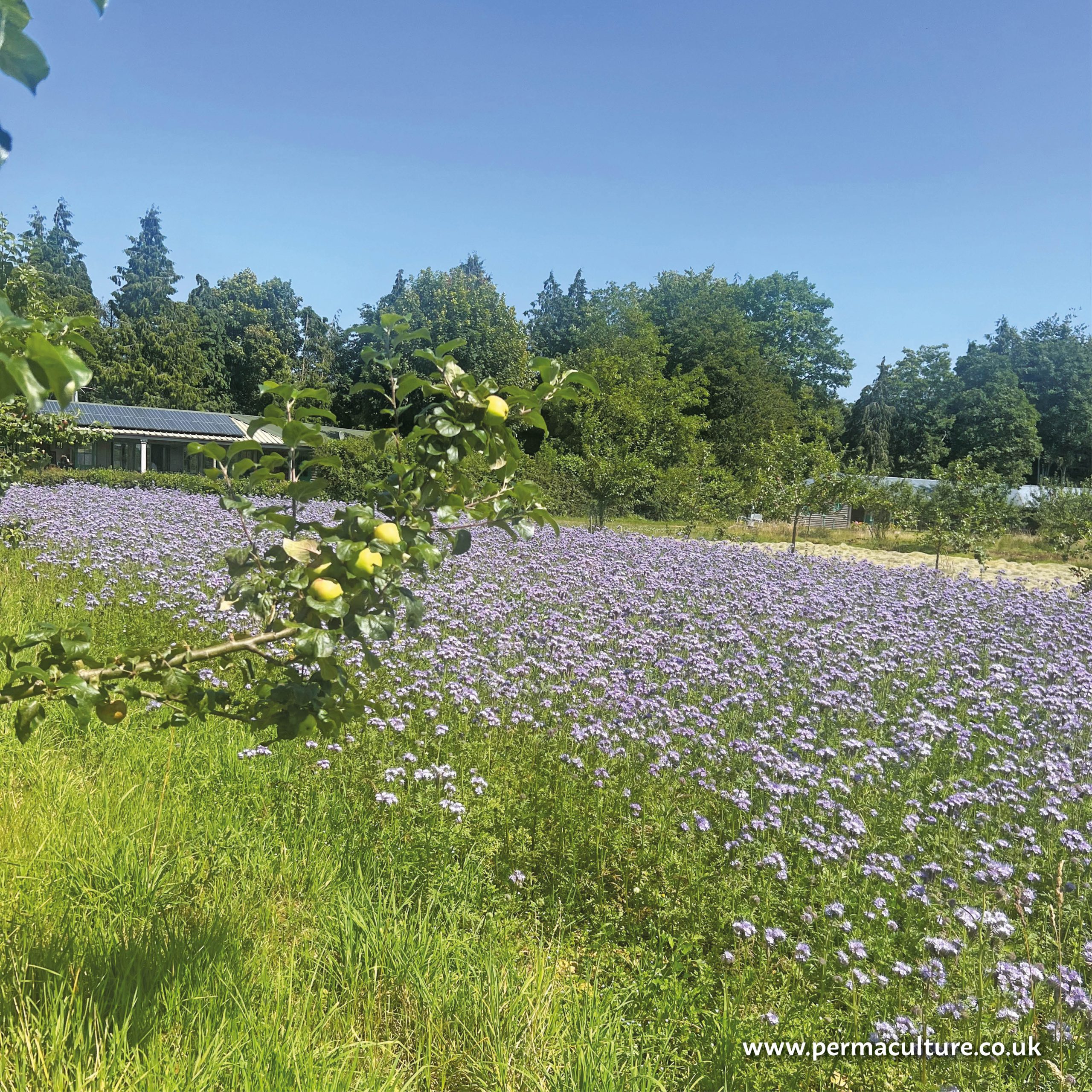
Cover crops in an agroforestry arable system, Gloucestershire
Crop diversity and polyculture
A key challenge in arable systems is to maintain plant diversity whilst producing a single crop, such as wheat, from a given field. One approach would be to develop and plant landraces as opposed to single cultivars. Landraces are genetically diverse, locally adapted varieties of a given crop, which change and adapt over time. Heritage wheats also tend to be far taller, co-exist with weeds and wildflowers, have low fertility requirements and provide a vast yield of straw, which can be used as fodder, fuel, and building material. It would also be important to challenge the overwhelming dominance of grains in arable systems. There are other annual crops that could replace some of the acreage currently devoted to cereals, which might also, depending on the landscape and local climate, be more suitable and resilient.
A more complex challenge is to create polycultures on a field scale, in which two or three annual crops are planted on the same field at the same time, or a single crop is grown with under sown green manures, as described by Masanobu Fukuoka (1978) and, more recently, by Gabe Brown (2018).
The role of perennial crops
It is not necessary to convert arable systems to perennial systems, and not just because they will have different outputs, but because there is an alternative middle way. There is no sense in which every arable farm needs to be converted to the type of perennial system advocated by Shepard (2013), as successful and useful as that is in the right circumstances and location. Perhaps, for most landscapes currently dominated by arable cropping, the best compromise is agroforestry, which combines multipurpose perennial crops with arable crops, and the replanting of hedges to separate fields into smaller parcels.
Complete integration with appropriate livestock
Nature’s blueprint is characterised by symbiotic relationships between soil, plants, and animals. Annual arable crops need to be integrated within a system that includes livestock, grasslands and arboreal cover. It is, by definition, a mixed farming system, in which herbivores play the central role in the maintenance of both grass and arable fields. Where permaculture theory can add value is by encouraging the arable farmer to think about what functions specific animals can play in the overall system, how they can benefit and shape the system beyond their immediate outputs. Can pigs be used to clear a field and cultivate it? Can ducks be used to control slugs? If so, how do we design the farm to incorporate space for these animals so that they can fulfil these additional functions?

Cows grazing in early spring on my old arable field in between crops. The field had been left fallow following the summer harvest. Credit: @escapetheofficejob
Water management
In much of the world, large scale arable farming relies on either rainfall or irrigation. The former is increasingly unreliable, and the latter is often reckless and unsustainable. The ability to maximise rainfall, and capture and store water is an area in which permaculture design could do much to build resilience in arable systems. Indeed, one of the many reasons to include perennials in the arable permaculture design is to hold water, prevent run-off, and provide shade.
Looking at energy flows
A key differentiator between permaculture and other systems of food production, including organic, is a holistic systems approach which looks at all the inputs to a system, and all its outputs, both desirable and undesirable. A major input in arable farming, including the very best practice organic systems, is energy, which is a prerequisite for field scale tillage, harvest, and transport. Machinery and tractors are mostly powered by fossil fuels, which means that there are significant industrial inputs and outputs in the system, leading all the way to the oil well or iron ore mine. For now, arable farming must rely on fossil fuels and mining to a significant degree. The ideal arable farm of the future might produce some of its power from high-tech watermills and windmills, from alcohol/biofuel made on site, and may reintroduce some horsepower for light work like harrowing and will generate its own heat through its own firewood or other clean, renewable sources of energy. Tractors could definitely already be far smaller and less energy intensive than the extravagant behemoths generally used on farms which, apart from being unnecessary and wasteful, contribute to soil compaction.
On-farm processing and direct marketing
Very few farms in the UK mill their own wheat and produce their own value-added products, such as bread and cakes, and most arable farmers do not eat food made with their crops. This commodification of arable outputs, and alienation between those who produce food and those who eat it, needs remedy. Permaculture ethics encourage ‘people to become self-reliant, and promote community responsibility’ (Mollison and Slay 1991): the localisation of crop production, processing, and consumption must be part of a more enlightened approach to arable farming.
Conclusions
Overall, permaculture and arable farming are not incompatible. Arable farmers need to adopt a whole-systems approach and not sacrifice the long-term viability of arable farming by focusing on outputs and ignoring the loose ends and liabilities inherent to all simplified, linear systems of production. Most importantly, permaculture invites the arable farmer to always observe and always ask questions. Why till? Why now? For what purpose? What are the short term and long-term consequences? How should we think about annual crops beyond this season and all foreseeable ones?
Arable farming: a definition
Arable farming generally refers to the cultivation of annual crops on a field scale. Arable farming dominates global food production, and produces the staple crops of humankind such as wheat, rice, maize, and legumes. The word ‘arable’ comes from the Latin arare, ‘to plough’ and an aratro, in modern Italian, is a plough. Arable farming is therefore a field (ager in Latin, from which the word agriculture derives) based activity; it involves tillage and cultivation of the soil; it is dominated by annual plants, especially grasses.
Arable farming: issues and limitations
The adoption of agriculture, as clear from the historical record, is ubiquitously associated with civilisation itself: all major civilizations past and present have depended upon the production of arable crops for their survival. These are crops that are high in yield, nutritional value, and storability. They can be traded, fed to livestock, and are easily adaptable to different geographies and climates.
This interdependence between agriculture and civilisation has been accompanied by several problems, which have afflicted, to varying degrees, most parts of the world where arable farming became the main source of food production. The primary consequences of the adoption of arable farming have included deforestation, soil erosion, loss of biodiversity, water scarcity, and overdependence on a limited range of annual crops. All these problems have been significantly exacerbated by the advent of industrial agriculture. Applying industrial methodology to arable farming has led to several additional problems, including:
Water and air pollution
Federico Filippi is Co-Founder and Director of Local Organic Growers CIC, a volunteer run not-for-profit company based in Watford growing produce for the local community. He is the author of Live to Eat or Eat to Live? Navigating food and dietary choices in a complex world. For more details and direct contact please visit: https://ffoodconsulting.co.uk
More on permaculture farming: